Choosing n8n by codability and integrability
Two tests separate AI automation tools: codability, meaning how much control the tool gives through code, and integrability, meaning how well it connects to your business systems.
AI is already reshaping everything
At workflows.diy, we build on an "AI-first" philosophy. AI is the primary engine of the software development lifecycle. The developer becomes an "AI orchestrator" or "AI lead developer" who guides the systems that build, test and deploy code.
Doing this well takes leadership from the top and a different technical approach to building and deploying solutions. Platforms like n8n.io offer tools for AI automation and agent development.
Tool choice matters most when you build AI agents and automated workflows. Our review of enterprise AI agent development tools draws on n8n's AI Agent Development Tools report. It points to two capabilities: codability and integrability.
Workflows and agents
Before comparing tools, it helps to separate two kinds of AI application.
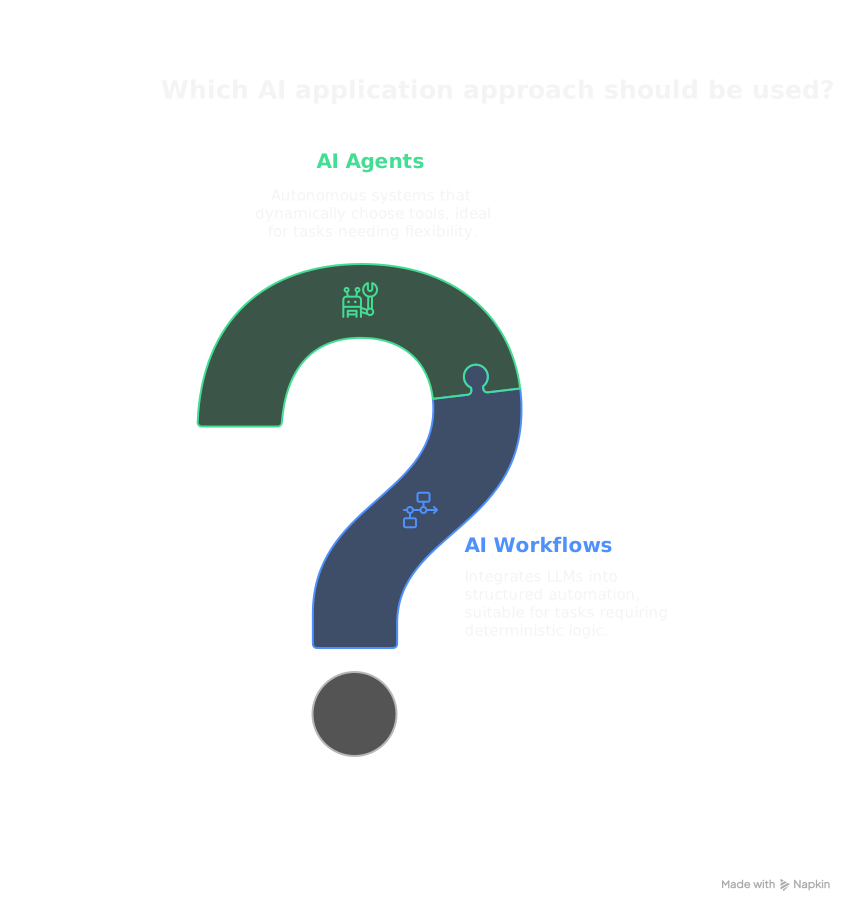
- An AI workflow puts an LLM inside structured, conditional automation logic. It is an AI-enhanced version of a traditional automation.
- An AI agent acts more autonomously. It can direct its own purpose and choose which tools or functions to use to reach a goal.
LLM outputs are non-deterministic. To build reliable applications with workflows or agents, you need deterministic logic that controls their inputs and outputs. Many AI agent development tools now use workflow-based GUIs for this. The visual interfaces let you write that control logic with little upfront training.
Testing tools for codability and integrability
Codability and integrability separate the options for complex agentic systems.
Codability gives precise control over AI agents
Codability describes a tool's code-based capabilities and extensibility. It gives developers fine-grained control over an AI agent's behavior, including how they configure models, use external frameworks and manage AI resource use. Strong codability includes:
- Support for native Integrated Development Environments (IDEs).
- Flexibility with multiple programming languages.
- Version control integration.
- Integration with AI frameworks like LangChain or LlamaIndex.
- Built-in features for agentic systems, such as reasoning loops, routing, memory management and function calling.
Tools that score high on codability let you customize an agent's core logic and how it talks to models.
As an AI-first developer, I use AI for 100% of my code generation. Tools with strong codability still matter when they offer a GUI, because they provide hooks, control points and transparency. The AI needs a structure it can see, read and change.
Integrability connects AI to your business systems
Integrability measures how well a tool fits into existing business processes and technical systems. It lets an agent push and pull data from databases, work with CRM and ITSM platforms, connect to security tools and run in DevOps pipelines. High integrability shows up as:
- Mature connections to your existing technology stack.
- Support for many triggers, such as webhooks, scheduled events and chat interfaces.
- Swappable AI components, so you can change models.
- Utility tools and pre-built connectors.
- Custom integrations.
- A library of ready-made content and templates.
Matching tools to your use case
No single tool fits every organization. The right choice depends on your use case, your existing technical stack and your AI goals:
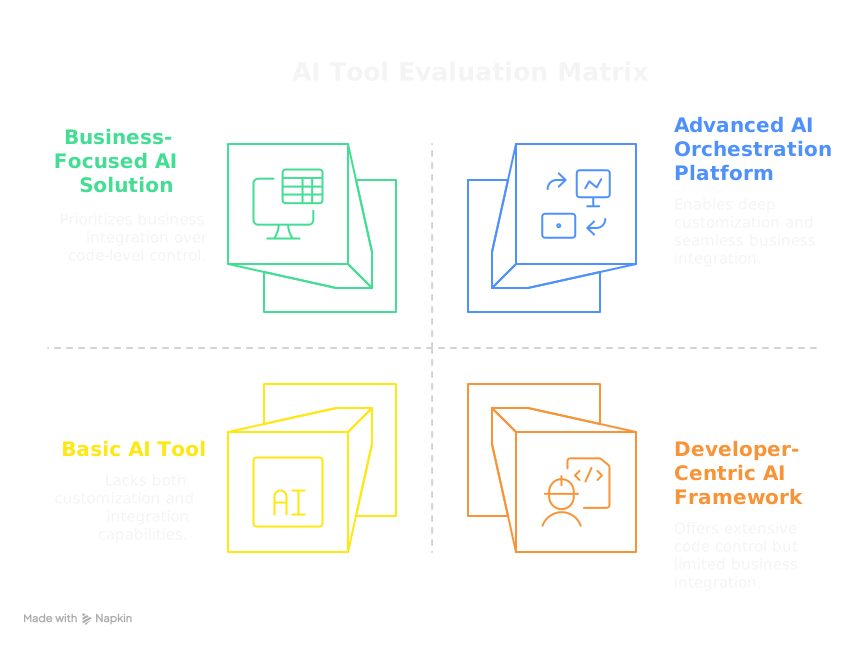
- Higher integrability, lower codability. Established workflow automation platforms that added AI features fit here. They suit complex, often legacy, IT stacks and simpler agents such as support chatbots or document summarization, where breadth of integration matters more than depth of agent logic. (Examples: Workato, Camunda, Make.)
- Higher codability, lower integrability. These are AI-native tools built for developing sophisticated agents. They give a high degree of control over agent behavior, which suits agentic systems that focus on web resources, SaaS applications and document processing. Connecting them deeply to a multifaceted enterprise IT stack can take considerable custom effort. (Examples: Vellum, Dify, Langflow, Flowise.)
- High on both integrability and codability. These tools offer versatile capabilities. They usually need more investment in training and onboarding. They suit highly complex workflows that connect deeply with your existing stack. n8n is noted for strong capabilities in both areas, which makes it a strong candidate for sophisticated AI-first development.
- Low on both integrability and codability. These tools take a lightweight, user-friendly approach that needs less training. They suit startups and small businesses that want basic AI agents with moderate configurability. (Examples: Stack AI, Relay.)
Comparing tools by theoretical capability, such as Turing completeness, is less useful than comparing native, out-of-the-box features. The criteria in the n8n report focus on these practical capabilities.
Strategy, people and tools drive AI success
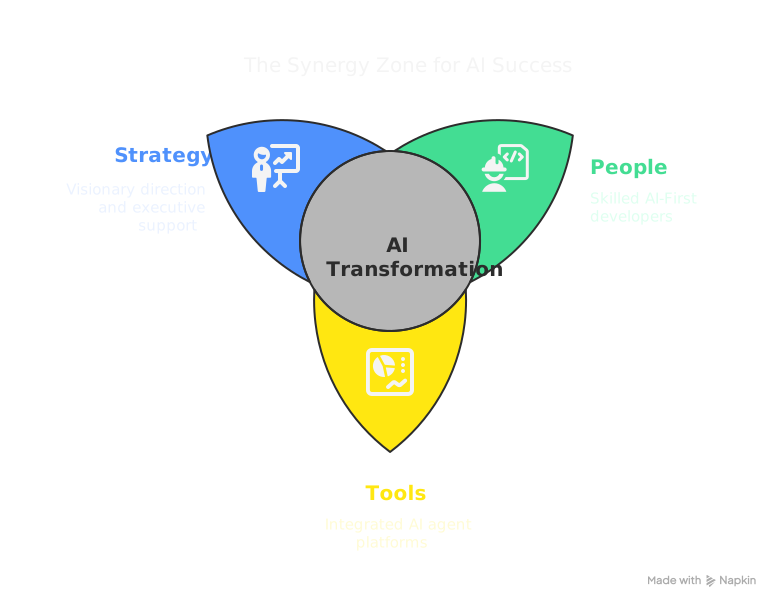
AI adoption is about more than buying tools. It depends on aligning strategy, people and tools.
- AI needs executive sponsorship and strategic direction from the CEO. The CEO's vision shapes how AI fits into the core business. Building an AI-first culture often takes dedicated leadership, such as a Fractional Chief AI Officer (CAIO).
- Technical implementation depends on a new kind of developer. The AI-first developer is an orchestrator who guides AI, not only a writer of code. Their value lies in AI collaboration, prompt engineering, critical thinking and validating AI-generated output. They need broad foundational tech knowledge to guide and validate AI, even when they do not code from scratch.
My project journals and blog posts show this. Google Gemini has built whole applications and integrations across Vue 3, Supabase, FastAPI, Docker, Tkinter, Three.js, Quasar and Electron, based on my architecture and iterative prompts.
Choosing an AI agent development tool means balancing codability for control against integrability for connection. The choice should match your AI strategy and what your development team can do. Many modern tools, n8n included, use workflow-based GUIs. Those suit an AI-first focus on defining logic and orchestration, rather than writing boilerplate code.
Partnering for your AI work
Turning AI tools into business value takes technical depth and strategic insight. Basic knowledge is easy to find. Applying it to your context takes dedicated support.
At workflows.diy, I combine hands-on experience as an AI-first software developer with a CEO-centric approach to AI strategy. I coach you and your team so you can own your AI initiatives. We pick tools for your needs, which often include n8n's AI capabilities.
If you are choosing AI tools or structuring an AI workflow team, get in touch.