May 29, 2025 · essay
The Evolution of "Fluid Dev" and How Conversational AI (could be) the New IDE
Discover 'Fluid Dev,' where conversational AI like Google Gemini transforms into your primary development environment, accelerating coding and shifting traditional IDEs to a supporting role. Embrace the future of developer velocity.
The short version
- LLM
- Google Gemini (e.g., in Google AI Studio) is the primary example of the conversational AI discussed, shaping the 'Fluid Dev' workflow. This post itself reflects on this AI-centric development philosophy.
- Why
- To articulate the evolution of 'Fluid Dev' – a development methodology where conversational AI is becoming the primary interface for coding, reducing reliance on traditional IDEs for core logic generation and significantly boosting developer velocity.
- Challenge
- Shifting the developer mindset and workflow from traditional IDE-centric coding (even with AI assistants) to a more conversational, AI-driven development process. This involves mastering contextual dialogue, systematic AI-guided code generation, and effective feedback loops with tools like Google AI Studio.
- Outcome
- A clear articulation of the evolved 'Fluid Dev' paradigm where conversational AI acts as the main 'IDE.' The post highlights the benefits: faster prototyping, lower barrier to entry, and a shift in developer focus from 'how' to 'what', with AI as a true collaborator.
- AI approach
- This post champions and describes an AI-First 'Fluid Dev' workflow where the developer primarily interacts with a conversational AI (like Google Gemini in AI Studio) to conceptualize, generate, and refine code. The AI acts as the primary 'coder' guided by human dialogue, making the conversational interface the new 'IDE'.
- Learnings
- Conversational AI can be guided to systematically generate near-complete and accurate code. The primary developer interaction is dialogue, contextual explanation, and providing rich feedback (like screenshots and stack traces). Traditional IDEs become more for execution and final debugging rather than primary code creation for many tasks.
Conversational AI (could be) the New IDE
The landscape of software development is undergoing a seismic shift, and at the heart of it is the concept of "developer velocity" – the sheer speed and efficiency with which we can bring ideas to life in code. We're moving beyond simply writing code faster; we're entering an era where the interaction with AI itself becomes the primary development environment. This is "Fluid Dev" evolving, where conversational AI, like Google's Gemini accessed through platforms such as Google AI Studio, is minimizing the need for traditional code editors and complex AI plugins for many tasks.
From Augmented Typing to Conversational Flow
Initially, AI coding assistants focused on autocompletion and generating snippets within familiar IDEs like VS Code. While these tools certainly boosted productivity, the paradigm is shifting. My own "Fluid Dev" technique has now largely transitioned to a conversational workflow. The process looks more like this:
- Conceptualization & Contextual Chat: I start by engaging in a dialogue with an AI like Gemini. I explain my thinking, provide the necessary context for the problem I'm trying to solve, and outline the desired outcome.
- Systematic, Step-by-Step Code Generation: Through this iterative conversation, the AI doesn't just provide snippets; it guides me through the process, systematically generating near-perfect code, step-by-step. It's like having an expert pair programmer who anticipates my needs and structures the solution logically.
- Copy, Paste, Run, & Feedback Loop: The code generated is often so complete that the primary action becomes copying it from the AI interface (like Google AI Studio) and pasting it into its execution environment. I then run the code.
- Iterative Refinement with Rich Feedback: If issues arise or modifications are needed, the feedback loop is also conversational. I provide screenshots of errors, stack traces, or describe the unexpected behavior directly to the AI. This rich, contextual feedback allows the AI to quickly understand the problem and provide targeted solutions or alternative code.
The Diminishing Role of Traditional Code Editors for Core Logic
What's striking about this evolved "Fluid Dev" approach is the reduced reliance on traditional AI-powered code editors for the core logic generation. The "heavy lifting" of coding is increasingly happening within the conversational AI environment. The IDE, in many instances, becomes more of an execution and debugging environment rather than the primary creation space. The need to meticulously write code line-by-line, or even rely extensively on in-editor AI suggestions, is diminishing for many common development tasks.
Why This Shift Matters
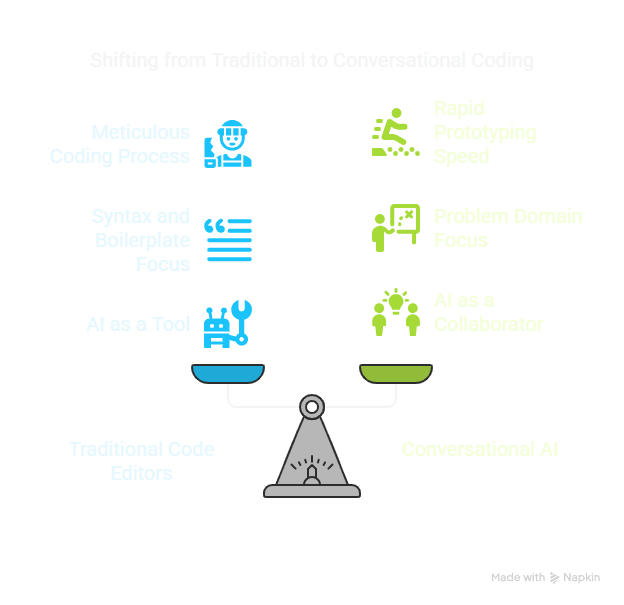
- Lowering the Barrier to Entry: This conversational approach can make complex coding tasks more accessible. The AI acts as a guide, making the process less daunting.
- Unprecedented Speed of Prototyping: Ideas can be translated into functional prototypes at a speed previously unimaginable. The back-and-forth with the AI allows for rapid exploration of different approaches.
- Focus on "What" not "How": Developers can concentrate more on the problem domain and the desired functionality, rather than getting bogged down in the minutiae of syntax or boilerplate code.
- AI as a True Collaborator: The AI is no longer just a tool; it's an active participant in the development process, offering guidance, generating solutions, and helping to troubleshoot.
The Future is Fluid (and Conversational)
While AI-generated code still necessitates human oversight, testing, and a strong understanding of underlying principles, the trend is clear. The "Fluid Dev" methodology, powered by increasingly sophisticated conversational AIs like Gemini, is reshaping what it means to be a developer. The primary interface for coding is, for many, becoming the chat window, where ideas are discussed, refined, and translated into functional reality with remarkable speed and precision. This isn't just about writing code faster; it's about a more intuitive, interactive, and ultimately, more powerful way to build.